
How to Teach Your Kids to Make Informed Food Choices + Enter to win a $100 Grocery Gift Card! #FocusOnTheFacts #ad
Funnel cakes, apple dumplings and cheesecake on a stick anyone? Yes, please! 😉
While enjoying these decadent treats is something we’re obviously quite obsessed with, it’s also important that we teach our son how important it is to make informed decisions about the food he eats. As parents, we can help make learning about the Nutrition Facts table fun for our kids!
This year at the Royal Winter fair, we were invited to stop by the #FocusOnTheFacts booth to test our knowledge of the Nutrition Facts table and play some games for a chance to win prizes! 🙂
In this post, I’m going to share with you a little about what we learned and how you can also encourage informed food choices with your kids at home!
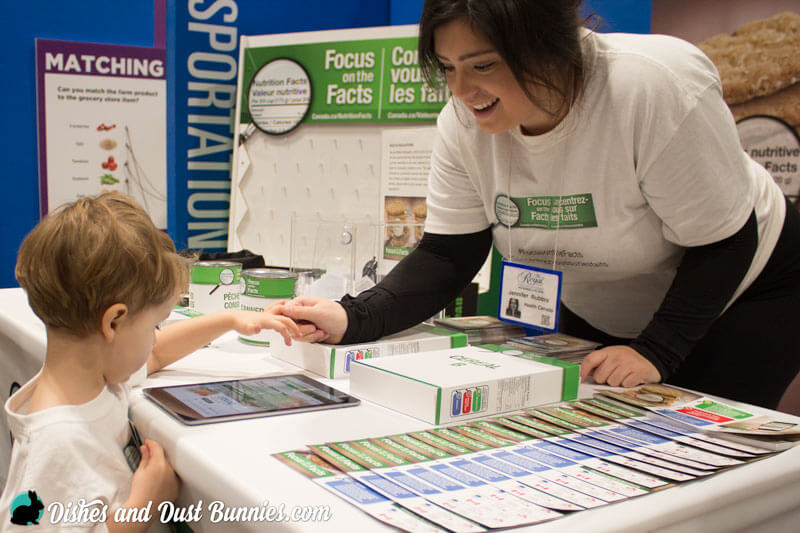
What is “Focus on the Facts”?
Focus on the Facts was created to help Canadians use the Nutrition Facts table (also known as the NFt) to make informed food choices by starting with the Serving Size and then looking at the Percent Daily Value (or the % DV as it’s shown on food packaging).
By using the Serving Size and % DV in the NFt, we can choose foods that have more of the nutrients we want and need like fibre and calcium, and less of the those we don’t want like saturated and trans fats and sodium.
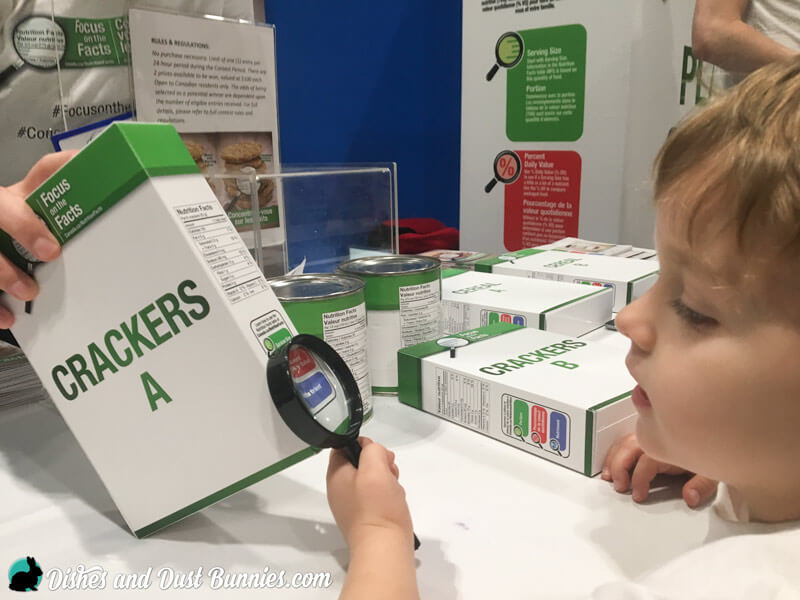
Last year, we were invited to take part in the Nutrition Facts Education Campaign at home as well, so Donnie was very excited to visit the #FocusOnTheFacts booth at the Winter Fair this year. Last time he got all dressed up in his cute little detective outfit to play “Nutrition Fact Finder”. He had loads of fun searching through the cupboards for food packages to investigate and compare the numbers on the Nutrition Facts table (NFt).
Teaching kids important life skills is so much easier when it’s fun!
This year at the #FocusOnTheFacts booth, we got a refresher on how to properly read the Nutrition Facts table, then answered a quick quiz. For each answer we got right, we received a ‘plinko’ chip to drop in the Focus on the Facts game.
We got 8/10 questions right, so Donnie got 8 chances to drop his chip in the game!
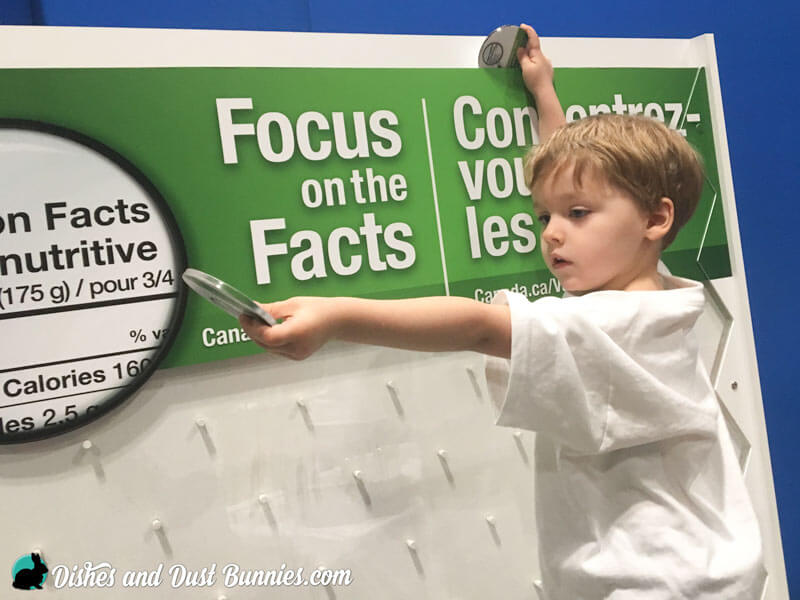
He loved watching the game pieces fall into the little compartments at the bottom. 🙂 We won a reusable grocery bag, which will definitely come in handy! Others who played the #FocusOnTheFacts game even won entries into a contest to win a grocery gift card!
Guess what??
You also have a chance to win a $100 Grocery Gift card when you enter the giveaway at the bottom of this page!
But first, let’s review the details. 🙂
How to Read the Nutrition Facts Table
- Start with the Serving Size, found under the header “Nutrition Facts”
- Then look at the Percent Daily Value (% DV) on the right side of the NFt
- Then use the % DV to see if the Serving Size has a little or a lot of a nutrient – 5% DV or less is a little and 15% DV or more is a lot.

After learning more about the Nutrition Facts table, I find it so interesting to see how products that look almost exactly the same can be so completely different in terms of their nutritional value.
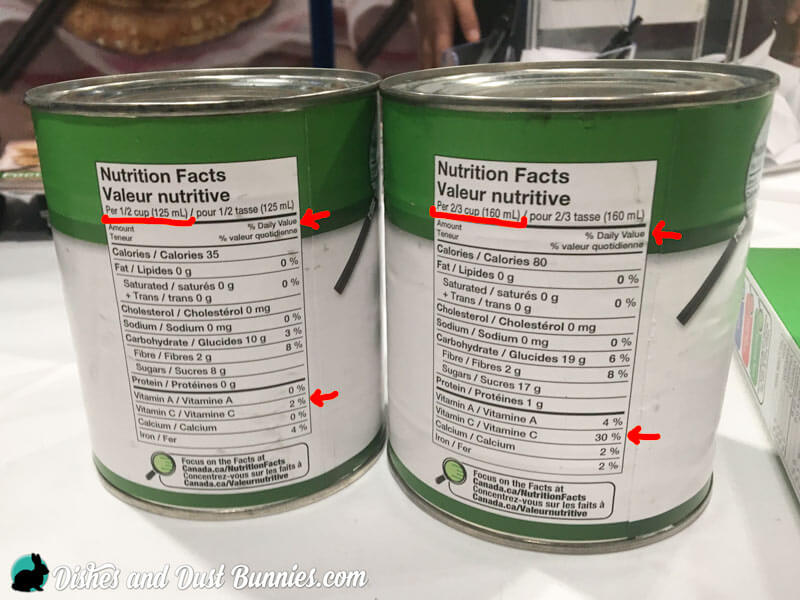
For example, if you look at the two cans of peaches in the picture below, you’ll see that there are 2 major differences.
One difference is the serving size for each product. The other difference is the Daily Value % for Vitamin C. The can on the left has what is considered a little bit of Vitamin C (2%) and the other has a lot (30%). Vitamin C is certainly good for you, but it’s so interesting to see just how much of a difference 2 of the “same” items can be!
Just remember though, that if a nutrient is listed as having a Daily Value of 5% or lower, it’s a little bit. If a nutrient is listed as having a Daily Value of 15% or more that’s a lot!
How to Teach Your kids to make Informed Food Choices:
- Be creative and get the kids to dress up as little Nutrition Fact Finder Detectives. You can see how we did it in this post – it was so much fun – try it with your kids! 🙂
- Review with your child how to read the Nutrition Facts table from the info you just learned. Then head on over to the #FocusOnTheFacts website to do the quick quiz. For each answer that your child gets correct, give them a little prize! It could be something as simple as stickers, or even a special treat. 🙂 Oh and I should mention, when you do the quiz, you also get a chance to win a $300 grocery gift card! That’s pretty awesome, right?! 🙂
- Next time you go grocery shopping, take your kids! Get them involved! Need pasta or some other ingredient for your next recipe? Get them to pick the package they think is best by comparing the Nutrition Facts table on each! This is a great way to make your kids feel involved and is excellent for encouraging them to make informed choices with their food.
You can find out more about the Nutrition Facts Table and how to use it to make informed food decisions at their site.
Don’t forget to Enter the Giveaway below for a chance to win a $100 Grocery Gift Card!
The giveaway is open to residents of Canada and will end Nov 25/2016, so don’t miss out!

I learned that 5% DV or less is a little and 15% DV or more is a lot.
we encourage them to make informed choices by involving them in the grocery buying and talking in depth about health labels
I learned that when you compare products, make sure you compare them with the right serving size. Also DV% of 15% or more is a lot
I learned that if a nutrient is listed as having a Daily Value of 5% or lower, it’s a little bit. If a nutrient is listed as having a Daily Value of 15% or more that’s a lot! Rafflecopter name: Anu Chopra
I learned how to read a nutrition label properly.
My tip is to get your kids to help meal plan and cook. It keeps them interested and gives them some say.
I learned about nutrients t – 5% DV or less is a little and 15% DV or more is a lot. Good to know.
I learned what the serving size actual is and not how much we think it is
I love the idea of making a game of it for the kids , something that will stick with them , great tip!
I am teaching my daughter how to read labels and how to portion out her meals.
My tip is to include the kids in the menu planning and shopping. Explain your choices and get them to help.
Visually show kids on a YouTube video or at home the actual amounts of sugar that is in processed foods & beverages. Like at my son’s dietitian there’s a poster that shows how much sugar is in soda, juice, iced tea, etc. & it’s very eye-opening, even for me as a parent! Then get them involved at the grocery store to help lessen those amounts based on the Nft.
I would teach them how to read food labels and the nutrition facts.
I teach them to read the label, ingredients that should be avoided.
I think kids should definitely be involved. It’s great to get them to look at the serving sizes and be aware of how much sugar, fat, etc they are taking in! Makes it easier to explain to them why good choices are important
I taught my kids how to measure out serving sizes with the food scale. They know that if the serving for a snack is beyond 200 calories then they reduce the grams enough to be under.
I learned that portion size is not always the same so you have to check that when comparing.
I learnt that you need to read the labels and look at the serving sizes
I like the idea of involving my kids at the grocery store and using the labels to help them make informed choices.
I like to encourage my little one to read the nutrition facts table on the snacks she loves in hopes that it becomes a habit.
I think when labeling if they could use maybe spoons or an icon so kids will know that they are suitable/Mom approved! This would be a great way to have kids learning younger! great review!
I learned that you always need to look at the serving size. My son is learning to look at the ingredients list, and if it is too long, to put the product back.
I have the kids reading the cereal boxes to see what the values are.
I leaned that 5% or less DV is less and 15% or more is a lot.
I love to show the kids how to make healthier choices by reading the facts on all the food items.
Very cool, looks like ur family enjoyed themselves
I learned that reading the facts can be very important, I have high blood pressure and I always check the sodium content on products
I think taking the kids to local farms to see where food comes from.
We use ‘serving sizes’ on the box at home and at the group home where I work. 6 small crackers may be a serving – and this is really eye opening for all of us! (I could eat half a box)
From this post I learned that a daily value of 5% or lower, is considered a little bit of that nutrient while a daily value of 15% or more is considered a lot.